
Call us now :08071630254
 Send Inquiry
 Send Inquiry
1,2-Dinitrobenzene Solution
MOQ : 1 , , Kilograms
1,2-Dinitrobenzene Solution Specification
- Molecular Formula
- C6H4N2O4
- Appearance
- yellow solid
- Usage
- Dinitrobenzene is a pale yellow or white crystalline (sand- like) solid which is usually a mixture of three isomers. It is used in making dyes, other chemicals, and explosives. * Dinitrobenzene is on the Hazardous Substance List because it is regulated by OSHA and cited by ACGIH, DOT, NIOSH, DEP, IRIS, NFPA and EPA.
- Melting Point
- 89.6 C (193.3 F; 362.8 K)
- Molecular Weight
- 168.107 Grams (g)
1,2-Dinitrobenzene Solution Trade Information
- Minimum Order Quantity
- 1 , , Kilograms
- Payment Terms
- Cash in Advance (CID), Cash Advance (CA)
- Supply Ability
- 500 Kilograms Per Month
- Delivery Time
- 2-8 Week
- Sample Available
- Yes
- Sample Policy
- Sample costs shipping and taxes has to be paid by the buyer
- Packaging Details
- Carton and Poly Bag.
- Main Export Market(s)
- Western Europe, Central America, Eastern Europe, Africa, Middle East, South America, Australia, Asia, North America
- Main Domestic Market
- All India
About 1,2-Dinitrobenzene Solution
1,2-Dinitrobenzene Analytical standard CAS Number 528-29-0 Linear Formula C6H4(NO2)2 Molecular Weight 168.11 grade analytical standard form neat application(s) HPLC: suitable gas chromatography (GC): suitable bp 319 C/773mmHg(lit.) mp 114-117 C(lit.) format neatFAQs of 1,2-Dinitrobenzene Solution:
Q: What is the melting point of 1,2-Dinitrobenzene Solution?
A: The melting point of 1,2-Dinitrobenzene Solution is 89.6 C (193.3 F; 362.8 K).Q: What is the molecular weight of 1,2-Dinitrobenzene Solution?
A: The molecular weight of 1,2-Dinitrobenzene Solution is 168.107 grams (g).Q: What is the molecular formula of 1,2-Dinitrobenzene Solution?
A: The molecular formula of 1,2-Dinitrobenzene Solution is C6H4N2O4.Q: What is the appearance of 1,2-Dinitrobenzene Solution?
A: 1,2-Dinitrobenzene Solution appears as a yellow solid.Q: What are the primary usage applications of 1,2-Dinitrobenzene Solution?
A: 1,2-Dinitrobenzene Solution is primarily used in making dyes, other chemicals, and explosives.Q: Why is 1,2-Dinitrobenzene Solution listed on the Hazardous Substance List?
A: 1,2-Dinitrobenzene Solution is on the Hazardous Substance List because it is regulated by OSHA and cited by ACGIH, DOT, NIOSH, DEP, IRIS, NFPA, and EPA.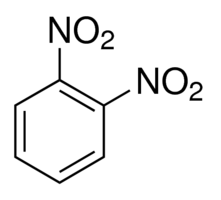
Tell us about your requirement

Price:
Quantity
Select Unit
- 50
- 100
- 200
- 250
- 500
- 1000+
Additional detail
Mobile number
Email

More Products in Analytical Grade Chemicals Category
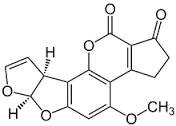
Compound feed (aflatoxin B1, blank)
Price 100 INR
Minimum Order Quantity : 1 , , Kilograms
Appearance : Offwhite powder
Physical Form : Powder
Usage : Direct animal feed blending or as raw ingredient
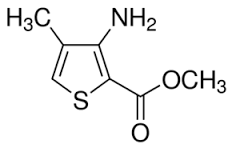
EPA 8020/8240 Aromatic Volatiles Mix
Appearance : Clear to lightcolored liquid
Physical Form : Other, Liquid mixture
Usage : Used as a calibration standard for EPA methods 8020/8240 in gas chromatography analysis
Molecular Formula : Not applicable (mixture of compounds)
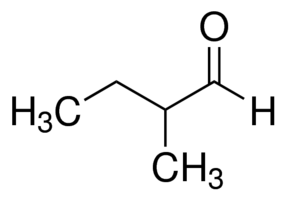
2- Methylbutyraldehyde
Price 100 INR
Minimum Order Quantity : 1 Kilograms
Appearance : Colorless Liquid
Physical Form : Liquid
Molecular Formula : C5H10O
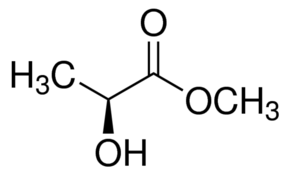
()-Methyl L-lactate
Price 100 INR
Minimum Order Quantity : 1 Kilograms
Appearance : colourless clear liquid
Molecular Formula : C4H8O3

 Send Inquiry
Our Products


Kesarkunj, Rm No. 9, Vasanji Lalji Road, Kandivali (W), Mumbai - 400067, Maharashtra, India

Mr Nilesh Shah
(Director)
Mobile :08071630254
 Send Inquiry
 Send SMS
 Call Me Free
Developed and Managed by Infocom Network Private Limited.
