
Call us now :08071630254
 Send Inquiry
 Send Inquiry
Asarylaldehyde (C10H12O4)
MOQ : 1 , , Kilograms
Asarylaldehyde (C10H12O4) Specification
- Purity
- 97%
- Molecular Formula
- C10H12O4
- Molecular Weight
- 196.2 Grams (g)
- Melting Point
- 234.32
- Usage
- Acrolein is mostly used to make acrylic acid. It is also used to control plant and algae growth in irrigation canals. Acrolein kills or controls microorganisms and bacteria in oil wells, liquid hydrocarbon fuels, cooling-water towers and water treatment ponds. In papermaking, acrolein is used to control slime.
Asarylaldehyde (C10H12O4) Trade Information
- Minimum Order Quantity
- 1 , , Kilograms
- Payment Terms
- Cash in Advance (CID), Cash Advance (CA)
- Supply Ability
- 500 Kilograms Per Month
- Delivery Time
- 3-4 Week
- Sample Available
- Yes
- Sample Policy
- Sample costs shipping and taxes has to be paid by the buyer
- Main Export Market(s)
- Western Europe, North America, South America, Eastern Europe, Middle East, Africa, Central America, Australia, Asia
- Main Domestic Market
- All India
About Asarylaldehyde (C10H12O4)
AsarylaldehydeCAS Number4460-86-0Linear Formula(CH3O)3C6H2CHOMolecular Weight196.20grade analytical standardassay 98.0% (HPLC)form neatshelf life limited shelf life, expiry date on the labelapplication(s) HPLC: suitablegas chromatography (GC): suitablemp 112-114C(lit.)format neatstorage temp. 2-8CFAQs of Asarylaldehyde (C10H12O4):
Q: What is the molecular formula and molecular weight of Asarylaldehyde?
A: The molecular formula of Asarylaldehyde is C10H12O4, and its molecular weight is 196.2 grams.Q: What is the purity level of Asarylaldehyde?
A: The purity of Asarylaldehyde is 97%.Q: What is the usage of Asarylaldehyde?
A: Asarylaldehyde is mainly used to make acrylic acid. It is also used to control plant and algae growth in irrigation canals, kill or control microorganisms and bacteria in oil wells, liquid hydrocarbon fuels, cooling-water towers, and water treatment ponds. Additionally, it is used in papermaking to control slime.Q: What is the melting point of Asarylaldehyde?
A: The melting point of Asarylaldehyde is 234.32C.Q: Can Asarylaldehyde be used for water treatment purposes?
A: Yes, Asarylaldehyde is used to kill or control microorganisms, bacteria, and algae in water treatment ponds and cooling-water towers.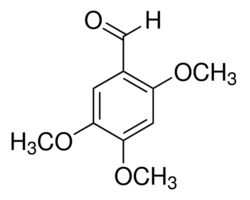
Tell us about your requirement

Price:
Quantity
Select Unit
- 50
- 100
- 200
- 250
- 500
- 1000+
Additional detail
Mobile number
Email

More Products in Analytical Grade Chemicals Category

Trizma base
Price 100 INR
Minimum Order Quantity : 1 Kilograms
Molecular Weight : 121.14 Grams (g)
Molecular Formula : C4H11NO3
Usage : It is used in the formulation of buffer solutions in the pH range between 7.5 and 8.5. TRIS buffer solutions are widely used in cell and molecular biology for processes such as protein and nucleic acid extraction and purification.
Melting Point : 175 °C
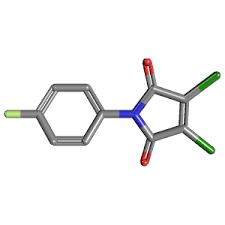
Fluoroimide
Price 100 INR
Minimum Order Quantity : 1 Kilograms
Molecular Weight : 260.04 Grams (g)
Molecular Formula : C10H4Cl2FNO2
Melting Point : 240.5241.8 °C;
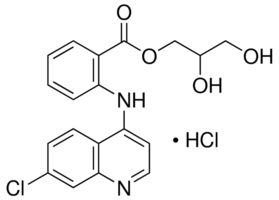
Glafenine hydrochloride
Price 100 INR
Minimum Order Quantity : 1 Kilograms
Molecular Weight : 409.3 Grams (g)
Molecular Formula : C19H18Cl2N2O4
Usage : A nonsteroidal antiinflammatory drug, glafenine and its hydrochloride salt were used for the relief of all types of pain, but high incidence of anaphylactic reactions resulted in their withdrawal from the market. It has a role as a nonnarcotic analgesic, a nonsteroidal antiinflammatory drug and an inhibitor.
Melting Point : 169 to 170 °C (336 to 338 °F)

Benzyl acetate
Price 100 INR
Minimum Order Quantity : 1 , , Kilograms
Molecular Weight : 150.18 Grams (g)
Molecular Formula : C6H5CH2OCOCH3
Usage : Benzyl acetate is also used for industrial uses, especially as a solvent in plastics and resins, nitrates, oils and lacquers. It is also an intermediate in the production other organic compounds.
Melting Point : −51.5 °C (−60.7 °F; 221.7 K)

 Send Inquiry
Our Products


Kesarkunj, Rm No. 9, Vasanji Lalji Road, Kandivali (W), Mumbai - 400067, Maharashtra, India

Mr Nilesh Shah
(Director)
Mobile :08071630254
 Send Inquiry
 Send SMS
Developed and Managed by Infocom Network Private Limited.
