
Call us now :08071630254
 Send Inquiry
 Send Inquiry
Binapacryl Solution
MOQ : 1 Kilograms
Binapacryl Solution Specification
- Usage
- Binapacryl is a fungicide not approved for use in the EU. It has a low aqueous solubility, is highly volatile and would not normally be expected to leach to groundwater. Binapacryl may be persistent in soil systems.
- Grade
- Analytical standard
- Purity
- 97%
- Melting Point
- 66 to 67 C (151 to 153 F; 339 to 340 K)
- Molecular Formula
- C15H18N2O6
Binapacryl Solution Trade Information
- Minimum Order Quantity
- 1 Kilograms
- Payment Terms
- Cash Advance (CA), Cash in Advance (CID)
- Supply Ability
- Kilograms
- Delivery Time
- 2-8 Week
- Sample Available
- Yes
- Sample Policy
- Sample costs shipping and taxes has to be paid by the buyer
- Packaging Details
- Carton and Poly Bag.
- Main Export Market(s)
- Asia, Australia, Eastern Europe, Middle East, Central America, Africa, South America, Western Europe, North America
- Main Domestic Market
- All India
About Binapacryl Solution
Binapacryl CAS Number 485-31-4 Empirical Formula (Hill Notation) C15H18N2O6 Molecular Weight 322.31 grade analytical standard form neat application(s) HPLC: suitable gas chromatography (GC): suitable format neatFAQs of Binapacryl Solution:
Q: What is the molecular formula of Binapacryl Solution?
A: The molecular formula of Binapacryl Solution is C15H18N2O6.Q: What is the primary usage of Binapacryl Solution?
A: Binapacryl is a fungicide, although it is not approved for use in the EU.Q: What is the purity of Binapacryl Solution?
A: The purity of Binapacryl Solution is 97%.Q: What is the grade of Binapacryl Solution?
A: The grade of Binapacryl Solution is Analytical standard.Q: What is the melting point of Binapacryl Solution?
A: The melting point of Binapacryl Solution is 66 to 67 C (151 to 153 F; 339 to 340 K).Q: Is Binapacryl persistent in soil systems?
A: Yes, Binapacryl may be persistent in soil systems.Q: Is Binapacryl likely to leach to groundwater?
A: No, Binapacryl would not normally be expected to leach to groundwater.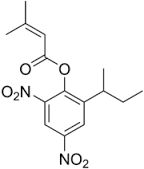
Tell us about your requirement

Price:
Quantity
Select Unit
- 50
- 100
- 200
- 250
- 500
- 1000+
Additional detail
Mobile number
Email

More Products in Analytical Grade Chemicals Category
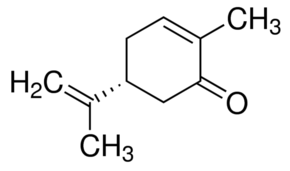
()-Carvone
Price 100 INR
Minimum Order Quantity : 1 Kilograms
Molecular Formula : C10H14O
Usage : Both carvones are used in the food and flavor industry. R(−)Carvone is also used for air freshening products and, like many essential oils, oils containing carvones are used in aromatherapy and alternative medicine. S(+)Carvone has shown a suppressant effect against highfat diet induced weight gain in mice.
Melting Point : 25.2 C

Trazodone hydrochloride
Price 100 INR
Minimum Order Quantity : 1 Kilograms
Molecular Formula : C19H23Cl2N5O
Usage : This medication is used to treat depression. It may help to improve your mood, appetite, and energy level as well as decrease anxiety and insomnia related to depression. Trazodone works by helping to restore the balance of a certain natural chemical (serotonin) in the brain.
Molecular Weight : 408.3 Grams (g)
Melting Point : 231 C
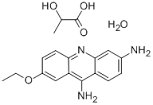
Ethacridine lactate monohydrate
Price 100 INR
Minimum Order Quantity : 1 Kilograms
Molecular Formula : C18H21N3O4
Usage : Ethacridine Lactate is a derivative of acridine, a yellow dyestuff with antiseptic action. It has been used as 0.05 to 0.2 per cent solution locally as an antiseptic. The 0.1 per cent solution which is used for inducing abortion is free of renal and cardiac toxicity, and is well handled and easily excreted.
Molecular Weight : 343.37 Grams (g)
Melting Point : 226 C
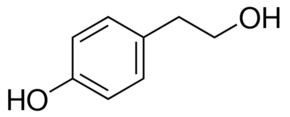
2-(4-Hydroxyphenyl)ethanol
Price 100 INR
Minimum Order Quantity : 1 Kilograms
Molecular Formula : C8H10O2
Usage : 2(4hydroxyphenyl)ethanol is a phenol substituted at position 4 by a 2hydroxyethyl group. It has a role as an antiarrhythmia drug, an antioxidant, a cardiovascular drug, a protective agent and a fungal metabolite. It derives from a 2phenylethanol.
Molecular Weight : 138.16 Grams (g)
Melting Point : 89.00 to 92.00 C

 Send Inquiry
Our Products


Kesarkunj, Rm No. 9, Vasanji Lalji Road, Kandivali (W), Mumbai - 400067, Maharashtra, India

Mr Nilesh Shah
(Director)
Mobile :08071630254
 Send Inquiry
 Send SMS
Developed and Managed by Infocom Network Private Limited.
