
Call us now :08071630254
 Send Inquiry
 Send Inquiry
Diquat dibromide-(ethylene-d4)
MOQ : 1 Kiloampere
Diquat dibromide-(ethylene-d4) Specification
- Molecular Weight
- 344.1 Grams (g)
- Appearance
- pale yellow, crystalline
- Melting Point
- 335 °C (635 °F; 608 K)
- Molecular Formula
- C12H12N2Br2
- Usage
- Diquat dibromide is a non-selective contact algicide, defoliant, desiccant and herbicide. As a herbicide/algicide it is used to control broadleaf and grassy weeds in non-crop (including residential) and aquatic areas. As a desiccant/defoliant, it is used on seed crops and potatoes.
Diquat dibromide-(ethylene-d4) Trade Information
- Minimum Order Quantity
- 1 Kiloampere
- Payment Terms
- Cash in Advance (CID), Cash Advance (CA)
- Supply Ability
- 500 Kiloamperes KG Per Month
- Delivery Time
- 2-8 Week
- Sample Available
- Yes
- Sample Policy
- Sample costs shipping and taxes has to be paid by the buyer
- Packaging Details
- Carton and Poly Bag.
- Main Export Market(s)
- Western Europe, Australia, Eastern Europe, Middle East, Central America, Africa, South America, Asia, North America
- Main Domestic Market
- All India
About Diquat dibromide-(ethylene-d4)
Diquat dibromide-(ethylene-d4) Synonym: 1,1-Ethylene-d4-2,2-dipyridylium dibromide Empirical Formula (Hill Notation): C12D4H8Br2N2 Molecular Weight: 348.07 grade analytical standard isotopic purity 98 atom % D assay 97.5% (HPLC) shelf life limited shelf life, expiry date on the labelFAQs of Diquat dibromide-(ethylene-d4):
Q: What is the primary usage of Diquat dibromide-(ethylene-d4)?
A: Diquat dibromide-(ethylene-d4) is used as a non-selective contact algicide, defoliant, desiccant, and herbicide. It controls broadleaf and grassy weeds in non-crop and aquatic areas. Additionally, it is utilized as a desiccant/defoliant for seed crops and potatoes.Q: What is the molecular formula of Diquat dibromide-(ethylene-d4)?
A: The molecular formula of Diquat dibromide-(ethylene-d4) is C12H12N2Br2.Q: What does the appearance of Diquat dibromide-(ethylene-d4) look like?
A: Diquat dibromide-(ethylene-d4) appears as a pale yellow crystalline substance.Q: What is the melting point of Diquat dibromide-(ethylene-d4)?
A: The melting point of Diquat dibromide-(ethylene-d4) is 335 C (635 F; 608 K).Q: What is the molecular weight of Diquat dibromide-(ethylene-d4)?
A: The molecular weight of Diquat dibromide-(ethylene-d4) is 344.1 grams (g).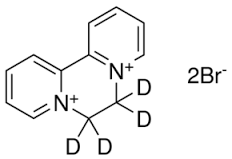
Tell us about your requirement

Price:
Quantity
Select Unit
- 50
- 100
- 200
- 250
- 500
- 1000+
Additional detail
Mobile number
Email

More Products in Analytical Grade Chemicals Category
EPA VOA Matrix Spike Mix
Usage : To spike water samples with known concentrations of target analytes for EPA methods
Appearance : Colorless liquid
Molecular Formula : Varied (mixture of specific organic compounds)
Molecular Weight : Varied (mixture of specific organic compounds)

Conductivity Standard - 600 mhos/cm
Usage : Used in laboratories and industries for calibrating conductivity measurement devices
Appearance : Clear colorless liquid

1,3,5-Trinitrobenzene
Price 100 INR
Minimum Order Quantity : 1 Kilograms
Usage : Trinitrobenzene is used primarily as a high explosive for commercial mining and military use. Some other uses include a narrowrange pH indicator, an agent to vulcanize natural rubber, and a mediating agent to mediate the synthesis of other explosive compounds
Appearance : Light yellow crystalline
Molecular Formula : C6H3N3O6
Molecular Weight : 213.1 Grams (g)

Transplatin
Price 100 INR
Minimum Order Quantity : 1 Kilograms
Usage : Transplatin. Transplatin is the lessactive isomer of the DNA damanging, platinum antitumor drug cisplatin, which is used in the treatment of a variety of solid tumors.
Appearance : yellow solid
Molecular Formula : Cl2H6N2Pt
Molecular Weight : 300 Grams (g)

 Send Inquiry
Our Products


Kesarkunj, Rm No. 9, Vasanji Lalji Road, Kandivali (W), Mumbai - 400067, Maharashtra, India

Mr Nilesh Shah
(Director)
Mobile :08071630254
 Send Inquiry
 Send SMS
 Call Me Free
Developed and Managed by Infocom Network Private Limited.
